
You flush your toilet, the waste disappears, and you probably never stop to ask where it goes.
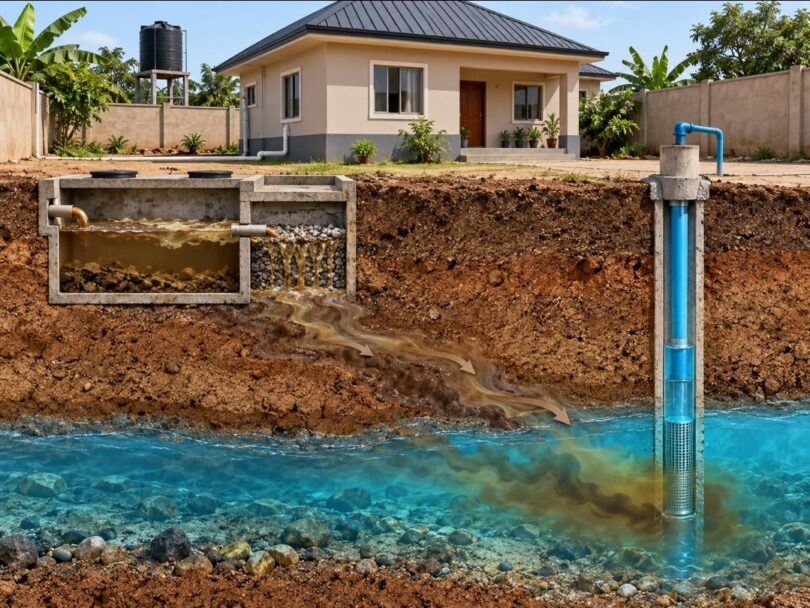
For millions of Nigerian households, particularly homes, estates and apartment buildings without access to public sewage systems, that waste eventually ends up in a septic tank or soakaway somewhere around the property.
At the same time, the same property may have a borehole providing water for drinking, cooking, bathing and other household activities.
This raises an important question:
Can waste from a septic tank eventually contaminate the water coming from a borehole?
The answer is yes, it can — but it depends on several factors.
A borehole does not produce water from nowhere. It draws groundwater from beneath the ground. That groundwater can move through layers of soil and rock beneath and around a property.
A septic tank, meanwhile, is designed to receive wastewater and separate solids from liquids. The liquid portion eventually moves into the surrounding soil through a properly designed drainage or soakaway system.
Under normal conditions, the soil acts as a natural filter. As wastewater travels through the ground, some contaminants are removed or reduced before the water reaches the groundwater system.
But that natural protection has limits.
If a septic tank or soakaway is leaking, poorly constructed, overloaded, damaged or too close to a borehole, contaminants from sewage can potentially migrate through the soil and reach groundwater.
Those contaminants can include disease-causing microorganisms such as bacteria, viruses and parasites.
And this is where the danger becomes difficult to detect.
Contaminated borehole water may look completely clean.
It may be clear.
It may have no unusual smell.
It may even taste normal.
Yet it could still contain microorganisms capable of causing waterborne disease.
WHY LOCATION MATTERS
One of the biggest issues is the distance and relationship between a borehole and a septic system.
The risk is not determined by distance alone. Soil composition, groundwater depth, the direction in which groundwater moves, the depth and construction of the borehole, the design of the septic system and local environmental conditions can all influence whether contamination reaches an underground water source.
This is particularly important in densely developed Nigerian estates where boreholes, septic tanks, soakaways, buildings and drainage systems may all be constructed within relatively limited spaces.
RAIN AND FLOODING CAN MAKE THINGS WORSE
Heavy rainfall presents another concern.
When the ground becomes saturated, wastewater may move differently through the soil. Flooding can also cause poorly maintained septic systems to overflow or allow contaminated surface water to enter improperly protected boreholes.
This means that a borehole that appears perfectly safe during dry weather should not simply be assumed to be safe throughout the year.
SO HOW DO YOU KNOW IF YOUR BOREHOLE WATER IS SAFE?
You cannot determine that simply by looking at the water.
The safest approach is laboratory testing.
Households that depend on boreholes should periodically test their water, particularly for microbiological contamination. Testing becomes even more important where there is a nearby septic tank or soakaway, flooding, changes in the taste or smell of the water, or a suspected sewage leak.
And there is another important lesson:
A domestic water filter should not be treated as a substitute for proper environmental planning and water testing.
The real solution starts with proper construction.
Boreholes should be appropriately sited. Septic tanks and soakaways should be properly designed and maintained. Potential sources of contamination should be kept away from groundwater sources as required by applicable standards and local conditions.
THE BOTTOM LINE
Having a borehole does not automatically mean you have safe drinking water.
Likewise, having a septic tank does not automatically mean your groundwater is contaminated.
The danger occurs when sewage systems are poorly designed or maintained and environmental conditions allow contaminants to reach groundwater.
So before taking the next glass of water from your borehole, ask yourself:
Where exactly is this water coming from — and what is happening underground around it?
Because when it comes to groundwater, what you cannot see may matter more than what you can see.
Clear water is not necessarily safe water. Testing is the only way to know.