
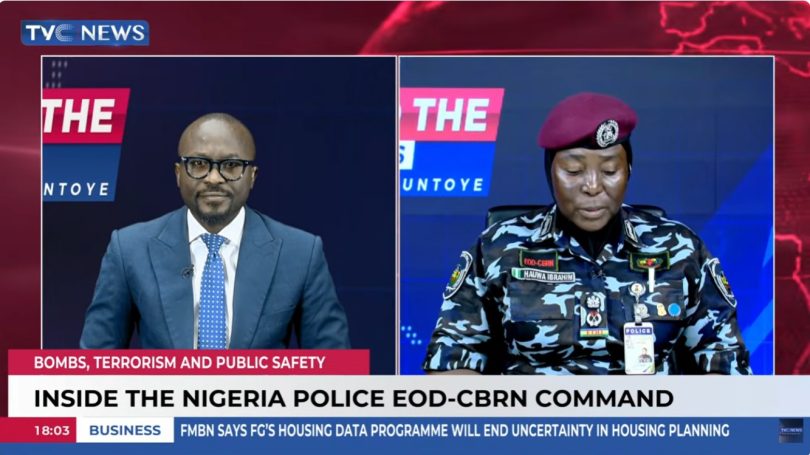
The Nigeria Police Force has warned Nigerians against touching or attempting to inspect suspicious or abandoned objects, stressing that what may appear harmless could be an improvised explosive device (IED) or other hazardous material capable of causing devastating consequences. Commissioner of Police (CP) in charge of Explosive Ordnance Disposal and……
The Nigeria Police Force has warned Nigerians against touching or attempting to inspect suspicious or abandoned objects, stressing that what may appear harmless could be an improvised explosive device (IED) or other hazardous material capable of causing devastating consequences.
Commissioner of Police (CP) in charge of Explosive Ordnance Disposal and Chemical, Biological, Radiological and Nuclear (EOD-CBRN) Command, Hawal Ibrahim, gave the warning during an interview on Beyond the Headlines with Nifemi Oguntoye, where she outlined the command’s responsibilities and urged citizens to play an active role in national security.
According to her, members of the public should immediately move away from any suspicious object, prevent others from approaching it, and report it to the nearest police station.
“If you notice an abandoned object, a suspicious package, a chemical odour, an unidentified powder or liquid, or any suspicious activity, do not touch it and do not go close to it. Keep yourself safe, move others away from the area and immediately report it to the nearest police station or other emergency authorities,” she said.
CP Ibrahim explained that while many Nigerians associate the EOD Command solely with bomb disposal, the unit performs a much broader national security role.
She said the command is responsible for preventing, detecting, responding to and neutralising threats posed by explosives, improvised explosive devices, chemical hazards, biological threats, radiological materials and nuclear incidents.
“Our mission is to protect lives, property and critical national infrastructure,” she said.
The commissioner noted that EOD personnel are deployed across Nigeria’s 36 states and the Federal Capital Territory, as well as airports, seaports and land borders, to prevent the movement and misuse of explosives and other hazardous materials.
Beyond responding to security threats, Ibrahim disclosed that the command closely regulates the use of commercial explosives in sectors such as mining, quarrying, oil and gas, and construction to prevent diversion to criminal or terrorist groups.
She said EOD officers escort explosives from manufacturers to storage facilities and project sites, while also supervising their use.
“From the manufacturers, EOD personnel escort explosives from one state to another. At the magazines where they are stored, our officers provide 24-hour security. We also supervise their transportation and usage to prevent misuse, diversion and illegal possession,” she explained.
The police chief stressed that explosive ordnance disposal is a highly specialised responsibility reserved strictly for trained EOD personnel.
She warned that no police officer outside the command is authorised to handle explosive devices because of the technical expertise and risks involved.
“Bomb disposal is strictly the responsibility of the EOD-CBRN Command. Nobody handles explosives except personnel who have undergone rigorous training on their safe management and disposal,” Ibrahim stated.
She added that the training is intensive and designed to prepare officers for high-risk operations where a single mistake could prove fatal.
CP Ibrahim revealed that many potential explosions are prevented before they occur through intelligence gathering and proactive operations.
She said the command works closely with communities and intelligence agencies to identify and neutralise explosive threats before they can be detonated.
“For a long time now, you hardly hear of explosions because of our proactive operations. We work with intelligence and communities, receive timely information, and quickly move to detonate devices before they explode,” she said.
The commissioner emphasised that public vigilance remains one of the strongest weapons against security threats, insisting that security is a shared responsibility between law enforcement agencies and citizens.
She urged Nigerians to report suspicious objects or activities immediately instead of trying to investigate them.
“If you see something, say something. Do not interrogate or touch any abandoned or suspicious object you find around you. Report it immediately to the nearest police station,” she advised.
Speaking on Nigeria’s preparedness for emerging global threats such as chemical, biological, radiological and nuclear (CBRN) attacks, Ibrahim said the Police Force is continuously strengthening its capacity through specialised training and international partnerships.
She noted that although Nigeria has not experienced large-scale CBRN attacks, the command is investing in advanced skills and preparedness to respond effectively should such incidents occur.
“We are strengthening our capabilities through rigorous training and partnerships with international organisations. We are building the capacity needed to respond effectively whenever such threats arise,” she said.
Reflecting on her nearly three decades in the Nigeria Police Force, Ibrahim, who recently became the first female Commissioner of Police to head the EOD-CBRN Command and the first female CP from Kano State, encouraged young Nigerian girls to pursue careers in security and other technical professions.
She urged them not to allow gender stereotypes to limit their ambitions.
“Leadership is not by gender. It is demonstrated through competence, integrity, discipline, courage and service. Believe in yourself, acquire the right skills and never allow stereotypes to limit your dreams,” she said.