…Seeks Emergency Funds, Moves To Review 100-Year-Old Quarantine Act
The Senate on Wednesday rejected a proposal for its committees to visit the Abuja airport through which an Ebola patient reportedly entered Nigeria from Uganda, even as it condemned the failure of aviation and health officials to screen the traveller.
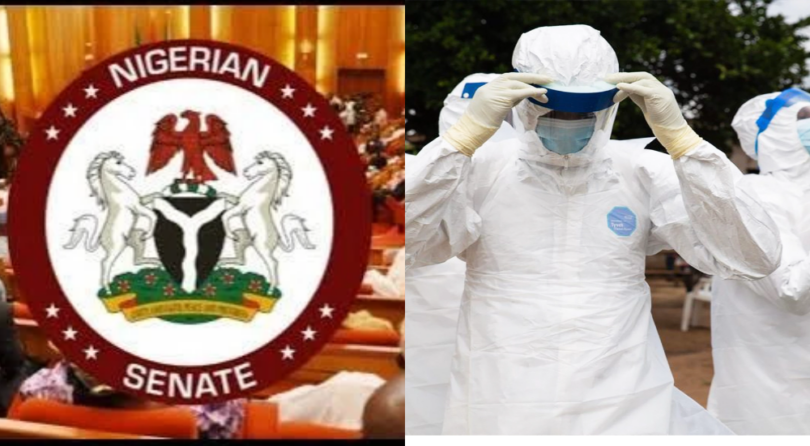
The lawmakers, however, adopted sweeping measures to prevent the spread of the deadly virus, including compulsory screening of all international passengers, immediate release of emergency funds and the replacement of Nigeria’s 100-year-old Quarantine Act.
The rejected proposal would have mandated relevant Senate committees to inspect the airport facility and report their findings to the chamber within four weeks.
The decision came during an extended debate on an urgent motion sponsored by Senator Francis Faduyile, a professor of medicine and specialist pathologist, following the confirmation of Nigeria’s first Ebola case in the Federal Capital Territory (FCT)
Senate President Godswill Akpabio expressed concern that the infected traveller reportedly entered the country without undergoing temperature checks or any form of health screening.
“There was no temperature check or any form of screening, and the traveller herself was worried,” Akpabio said, suggesting that the infection might have been detected only after the patient arrived at a hospital.
The Senate subsequently declared the situation a national health emergency requiring urgent and coordinated intervention.
In one of the resolutions adopted, the Senate directed that health screening be made compulsory for all arriving international passengers at every international airport, seaport and designated land border.
The measures are to include health declaration forms, temperature checks and symptom screening, with enhanced checks for travellers who visited or transited affected areas within the preceding 21 days.
Senator Ali Ndume, representing Borno South, argued that screening must not be restricted to travellers from countries already designated as high-risk, warning that the latest case exposed the danger of relying on a limited list of affected countries.
“You don’t know where a person contacted Ebola. Screening must be mandatory for every traveller coming into this country at every airport, regardless of origin,” Ndume insisted.
The Senate also called on the Federal Ministry of Health and Social Welfare, the Federal Airports Authority of Nigeria and the Nigeria Immigration Service to adequately staff and equip all entry points with trained Port Health officers, thermal scanners, personal protective equipment and isolation rooms.
It further urged the authorities to ensure that isolation and treatment centres were ready across the 36 states and the FCT.
Citing the urgency of the situation, the lawmakers resolved that the National Assembly should urgently repeal and replace the Quarantine Act of 1926 with a modern public health law aligned with the International Health Regulations of 2005.
Senator Mohammed Tahir Monguno, representing Borno North, described the existing legislation as obsolete and inconsistent with contemporary public health realities.
He urged the National Assembly to enact a new legal framework that would empower health officials to respond effectively to emerging infectious diseases and deploy modern screening and surveillance technologies.
Akpabio directed the Senate Committee on Judiciary to engage relevant health authorities and the executive on the proposed legislative changes without waiting for an executive bill.
Senator Sadiq Suleiman Umar, representing Kwara North, said Nigeria must not squander the international recognition it earned for containing the 2014 Ebola outbreak.
He called for coordinated action by relevant agencies, adequate funding and strict border control, warning that there could be no justification for porous entry points.
Senator Adamu Aliero, representing Kebbi Central, also described the motion as timely, stressing the need for urgent action against a disease associated with a high fatality rate.
The question of emergency funding generated further debate, with lawmakers insisting that Nigeria could not afford to delay intervention until the 2027 budget.
While the motion initially proposed adequate funding in the next budget, Aliero moved an amendment urging the Federal Government to release emergency funds immediately from the Service Wide Vote.
The amendment, seconded by the Senate Leader, was adopted.
Ndume had earlier claimed that President Bola Tinubu had approved N10bn for Ebola control and demanded its immediate release and proper accounting.
Akpabio, however, distinguished between approval and actual release of funds, noting that the Senate had no evidence before it that the money Ndume referred to had been disbursed.
Senator Ireti Kingibe, representing the FCT, urged the government to ensure that available resources were deployed to strengthen preventive measures, particularly in Abuja, where the case was detected.
Faduyile cautioned against calls for indiscriminate vaccination, explaining that the Bundibugyo and Sudan Ebola strains had no approved vaccines and that the strain involved in Nigeria’s case had yet to be determined.
He said vaccination, where an appropriate vaccine was available, was generally deployed through targeted ring vaccination around an outbreak rather than indiscriminate mass vaccination.
Faduyile, in his motion, warned that Nigeria faced a high risk of importing additional cases amid the Ebola outbreak in the Democratic Republic of Congo and its reported spread to other African countries.
He said contact tracing linked to the Abuja case had identified about 44 persons for quarantine and observation, while the Nigeria Centre for Disease Control and Prevention had rated the country’s risk of importation as high.
The senator also blamed gaps in screening procedures, noting that restrictions introduced on September 22 had focused on travellers from selected countries of concern, leaving room for infected persons travelling through other countries to escape scrutiny.
He warned that Nigeria, already grappling with Lassa fever, cholera and diphtheria, could face a serious public health crisis if the Ebola threat was not contained.
Akpabio recalled the 2014 outbreak, when the introduction of the virus by a Liberian traveller, Patrick Sawyer, led to infections among health workers, including a medical doctor, Ameyo Stella Adadevoh who died, after handling Sawyer’s case.
With 44 contacts already identified, Akpabio warned that further transmission could trigger a dangerous chain reaction. “This is a major wake-up call,” the Senate President said.
The Senate urged the Ministry of Health and relevant agencies to ensure that public and private facilities, including hotels, schools, ministries, institutions and event centres, provide hand sanitisers and other preventive measures.