Nigeria would mark 10 consecutive years without a state execution, meeting the international standard for a de facto moratorium. However, over 3,000 persons are on prolonged death row detention.
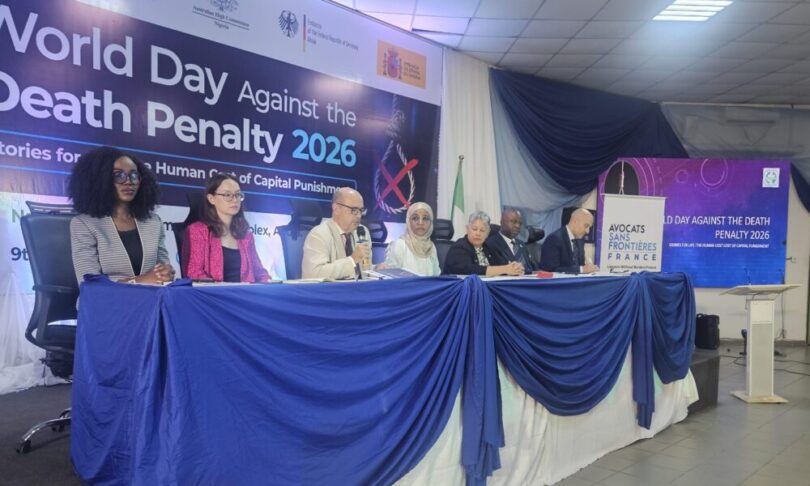
The National Human Rights Commission (NHRC), Avocats Sans Frontieres, Australian High Commission, Embassy of the Federal Republic of Germany and the Spanish embassy in Nigeria on Friday called for the revocation of the death penalty in Nigeria.
The NHRC’s Executive Secretary, Tony Ojukwu, represented by the Director of Legal Services and Enforcement, Rabir Anwar, called for “transition of Nigeria’s tenure clause into an official, effective moratorium on execution.”
“The commission urges the government to systematically revoke Section 312 of the Constitution and Section 122 of the Nigeria Correctional Service Act to commute death sentences to life imprisonment,” he said.
Mr Ojukwu, a Senior Advocate of Nigeria, said that by December, Nigeria would mark 10 consecutive years without a state execution, meeting the international standard for a de facto moratorium. However, over 3,000 persons are on prolonged death row detention.
The Australian High Commissioner to Nigeria, Leilani Bin-Juda, commended Nigeria for reaching the de facto moratorium on executions.
“Behind every death sentence are individuals, families and communities whose lives are profoundly affected by the decisions of the justice system,” she said.
Ms Bin-Juda explained that Australia opposes the death penalty in all circumstances and for all people, because we believe it is a cruel, inhumane and degrading punishment that has no place in a modern justice system.
While she recognised Nigeria’s autonomy as an independent state, Ms Bin-Juda encouraged the nation to consider formalising its de facto moratorium on executions or narrow the range of offences over which the death penalty may be imposed.
Like Australia, the Ambassador of Spain to Nigeria, Felix Costales Arteida, said Spain opposes the death penalty because “life is an inalienable right, and no state should have the power to take it away.”
He said, “There is no evidence that capital punishment acts as a greater deterrent than other penalties involving the deprivation of liberty.
“Yet it is undoubtedly irreversible, eliminating any possibility of correcting judicial errors.”
Citing the US as an example, he said that since 1973, 130 people sentenced to death have been found innocent since 1973 and released from death row.
Mr Arteida said the strength and justice of a society are not “measured by the severity of its punishments, but by its capacity to protect the fundamental rights of all people, even in the most difficult times.”
He also encouraged the Nigerian government to review capital punishment. Doing this is not a sign of weakness but a demonstration of strength, he said.
Lorena Moore, who represented the German Ambassador, acknowledged the need for justice, but stressed that taking the life of another human being can never be the solution to the justified need for justice.
The Country Head, Avocats Sans Frontières France Angela Uzoma-Iwuchukwu, expressed commitment to advocating against the death penalty, describing it as a violation of the right to life.
“It is discriminatory because it targets the weakest in our society. It is used disproportionately against the poor.”
Guests who graced the commemoration of the World Day Against the Death Penalty at the NHRC included the Ambassador of Belgium, Patrick Englebert, the representative of the European Union, the representative of the President of the Nigerian Bar Association (NBA), Oghenero Okoro, and Italian Ambassador, Roberto Mengoni.
The Nigerian Correctional Service, Comptroller-General Sylvester Nwakuche, represented by Comptroller Olufemi Oluyemi, the men and women on death, whom, he said, prison officers often come in contact with, “are not merely case files or numbers.”
“We meet them every day, in the yard, in the workshop, in the classroom, in the chapel, in the mosque, all around us. We also hear the stories of the families who wait for them, and we remain conscious of the stories of victims and communities whose pain must never be forgotten,” he said.
He noted that whatever the direction of the national conversation on the death penalty, the NCOS will stand ready to play its part with professionalism, humanity, and integrity to the law.
This year’s theme for the World Day Against the Death Penalty is Stories for Life: the human cost of capital punishment.
Amanda Arthur, a 21-year-old daughter of death row survivor Angel Arthur, gave a testimonial of his father to illustrate the theme of the day.
Mr Arthur was imprisoned when he was 21 years old and spent 16 years in prison. His name was later removed from the list of those to be executed. He insisted that he was wrongfully imprisoned.
His daughter on Friday said her father never forgot his awful experience and his story always resonated in the house. Ms Arthur said this has impacted their lives and view of society.
“It’s made me conscious, super conscious of things around me because I know at any point in time I could be a victim or I could be a perpetrator. The trauma has stuck with us,” she said.
“A very subconscious stigma: the moment you say your parent has been in prison, everybody starts looking at it differently.”
Speaking on the death penalty, she said that, guilty or not, no human should undergo such punishment. “It’s dehumanising.”
Amnesty International reported that as of 2025, 145 countries have abolished the death penalty both in law and practice.