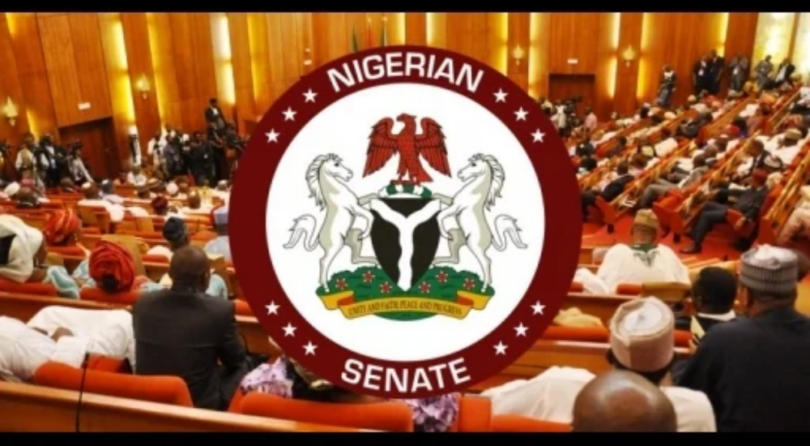
The Senate has urged the Federal Government to renegotiate Nigeria’s Bilateral Air Service Agreement (BASA) with China, threatening a review of the pact if Nigerian airlines are denied the same flight opportunities enjoyed by Chinese carriers.
The resolution followed a motion sponsored by Senate Leader, Mohammed Monguno (Borno North), and seconded by Abdul Ningi (Bauchi Central), which attracted widespread support during plenary.
Leading the debate, Monguno said bilateral trade between Nigeria and China reached $18bn in the first half of 2025, representing a 25 per cent increase over the corresponding period, while total trade stood at $28bn in 2024.
He argued that the growing economic relationship made direct air connectivity imperative.
He lamented that the BASA, signed under former President Muhammadu Buhari, had not delivered the expected reciprocal benefits for Nigerian airlines.
According to him, direct flights would reduce travel time, boost trade, retain foreign exchange, strengthen supply chains and position Lagos and Abuja as aviation gateways between West and Central Africa and East Asia.
Seconding the motion, Ningi described it as patriotic but raised concerns over alleged illegal mining activities by Chinese nationals in Bauchi and other parts of the country.
He accused some operators of exploiting mineral resources without adequate regulatory compliance and exporting raw minerals without sufficient local processing, calling for stronger government oversight.
On aviation, Ningi said Nigerian travellers often had to connect through Morocco, the United Arab Emirates, Ethiopia and the United Kingdom to reach China because of the absence of direct flights by Nigerian carriers.
He urged the government to support indigenous airlines, including Air Peace, United Nigeria Airlines, Azman Air and Ibom Air, to operate the route, subject to regulatory requirements.
He insisted that Nigeria should not continue granting Chinese airlines access to its aviation market without equivalent opportunities for Nigerian operators, calling for a review of the agreement if Beijing failed to guarantee reciprocity.
Supporting the position, Senate President Godswill Akpabio renewed calls for a national carrier, arguing that Nigeria needed a strong indigenous airline to compete internationally and reduce dependence on foreign operators.
Following deliberations, the Senate adopted the motion, urging the Ministries of Aviation and Aerospace Development and Foreign Affairs to renegotiate the agreement, facilitate business visas for Nigerian traders and secure reciprocal flight slots for Nigerian airlines.
It mandated its Committees on Aviation and Foreign Affairs to monitor implementation and report back within four weeks, while noting that a separate substantive motion would be required to consider the proposed revival of a national carrier.