
By 4:30am, Gabriel Diko is already on the road.
The civil servant leaves his home in One Man Village, Nasarawa State, at that hour in the hope of reaching his workplace in Abuja before the morning rush becomes unbearable.
But even leaving before dawn no longer guarantees a smooth journey.
On some days, Diko still meets traffic while most of the city is asleep, and by the time he gets to work, the journey that should take less than an hour has consumed several hours.
For residents, traders and commuters along the Abuja-Nasarawa corridor, the problem is no longer simply traffic.
It is lost working hours, lost income, difficult access to businesses, exhausting journeys and, in some cases, anxiety over whether a sick person trapped in the gridlock will make it to hospital on time.
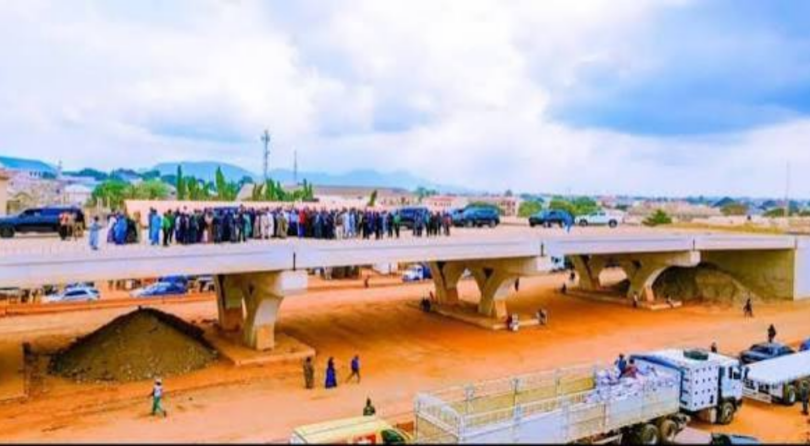
The disruption has intensified around the Mararaba axis, where the ongoing construction of the 2.6-kilometre Mararaba-Nyanya flyover and adjoining road project has narrowed the space available to commuters.
The project, being handled by Triacta Nigeria Limited, was flagged off by the Nasarawa State Government in December 2025 at a reported cost of N39 billion. The government said the project comprises two flyover bridges, an elevated road and pedestrian bridges and is intended to ease congestion along the Mararaba-Nyanya corridor.
But while the eventual project is expected to improve movement, people who depend on the road every day are currently bearing the consequences of its construction.
THE WHISTLER visited the corridor on a Wednesday morning and found traffic tightly packed around the construction area.
The available lanes have been narrowed to accommodate the construction, forcing motorists moving in both directions to navigate limited space around the work zone.
The pressure is particularly visible around Mararaba Market, a commercial hub known for its heavy daily influx of traders, customers and vehicles.
But the market did not look as busy as expected.
Several shops were shut despite the early morning trading period, while traders who opened their businesses had to contend with the condition of the road outside their shops.
When it rains, the situation becomes worse.
Sections of the available road become muddy and waterlogged, leaving motorists struggling to manoeuvre and pedestrians searching for ways through the flooded portions.
Vehicles sometimes become stuck in the mud, further slowing movement and adding to an already difficult traffic situation.
For commuters, a journey that previously took about 30 minutes to an hour can stretch beyond five hours when heavy rainfall coincides with the gridlock.
Some travellers have resorted to sleeping in their vehicles after spending hours trapped on the road.
‘We have lost a significant number of wholesale customers’ Ndubuisi, a trader at Mararaba Market told THE WHISTLER that the construction has affected his business at almost every level.
“My name is Ndubuisi, and this road construction is seriously affecting us at every level. If it rains, no customers come to the shop again because everything will be flooded and muddy” he bemoaned.
He said the congestion also creates difficulties for traders receiving goods, noting that the biggest loss has been the disappearance of wholesale customers who previously drove into the market to buy goods.
“The road is so congested that people and motorists struggle to navigate. And when goods arrive, there is no space to offload.
“Now walk-in customers who are wholesalers have left this market, they can’t drive into the market, and the stress of navigating the road has made it difficult for them. So, they source goods elsewhere.
“We have lost a significant number of wholesale customers,” he said.
The effect extends beyond the market itself.
With the road serving as a major connection between Abuja and communities in Nasarawa State, its condition has made ordinary movement difficult for people travelling in either direction.
During THE WHISTLER’s visit, some of the routes available to motorists were already muddy, while water accumulated in damaged portions of the road after rainfall.
The road from the Abuja Building Materials Market towards Mararaba has become particularly difficult to navigate, with no temporary diversion or alternative route readily available to take pressure off the main corridor.
During the rainy season, commuters are forced through muddy and damaged portions, while the dry season brings thick dust.
For workers who leave home early to beat the traffic, the consequence is often the same: hours lost before the working day properly begins.
Some arrive at work exhausted and covered in dust or mud.
‘The worst-case scenario is the rainfall’ another trader who identified himself simply as Alhaji Isa recounted that the rainy season presents the most difficult conditions, although the dry season comes with its own problems.
He said the construction company should have done more to make the temporary road usable.
“And when it’s not raining, the place becomes dusty, but the worst-case scenario is the rainfall.”