
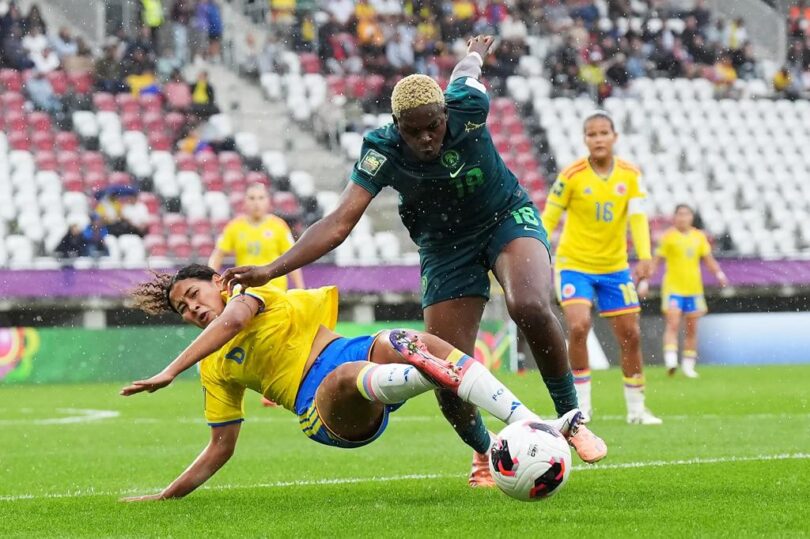
Moses Aduku’s side will leave Poland wondering what might have been after a game in which they created opportunities, survived periods of Colombian pressure and continued fighting even after being reduced to 10 players
For almost 92 minutes in Łódź, Nigeria’s Falconets kept their FIFA U-20 Women’s World Cup dream alive. But, in a cruel twist that summed up the fine margins of knockout football, Colombia found the breakthrough.
Nigeria had arrived at the last eight with renewed belief after a spectacular turnaround in Poland. After failing to win either of their opening two group matches, the Falconets exploded into life with a 10-1 demolition of New Caledonia before producing one of their most impressive performances of the tournament in a 3-0 victory over England in the round of 16.
That victory had raised hopes of a return to the semi-finals for the first time since 2014. Instead, Moses Aduku’s side will leave Poland wondering what might have been after a game in which they created opportunities, survived periods of Colombian pressure and continued fighting even after being reduced to 10 players.
PREMIUM TIMES looks at the five major talking points from Nigeria’s painful quarter-final exit.
The first major talking point is the one that will hurt the most: Nigeria were once again denied a place in the semi-finals.
The Falconets came into the tournament with a proud history at this level and had reached the quarter-finals for a ninth time, but their last appearance in the final four remained the 2014 edition in Canada, when the team finished as runners-up.
Although they didn’t go into the tournament with a full strength squad due to Visa issues of the Captain Joy Igbokwe and 2 others, alongside injuries to about four Key players, there was genuine belief that this generation could finally break that long wait.
The 3-0 win over England had provided the perfect springboard and platform for optimism, as Seimeyeha Janet Akekoromowei produced a superb left-footed volley, while Christiana Uzoma kept a clean sheet and saved Rachel Maltby’s penalty, with Nigeria eventually completing a convincing victory.
Against Colombia however, the margin between advancing and going home was reduced to a single moment. The Falconets were seconds away from extra time when Loboa reacted quickest after her initial effort was blocked by Uzoma, converting the rebound to send Colombia into the last four.
For a team that had spent years chasing another semi-final appearance, the manner of the elimination makes the disappointment even harder to absorb.
If there was one recurring frustration throughout the quarter-final, it was Nigeria’s inability to turn attacking opportunities into goals.
The Falconets had their moments; Janet came closest early when she struck the crossbar with a precise effort from the edge of the box in the 19th minute.
Tumininu Adeshina then forced Colombia goalkeeper Luisa Agudelo into action with a powerful long-range effort in the 38th minute, with the goalkeeper tipping the ball over the bar.
Nigeria also threatened after the break through Akekoromowei, Tumininu Adeshina, Favour Nkwocha, Tosin Rafiu and Onyedikachi Ekezie. But the decisive touch never arrived, and that was ultimately the difference.
At this level, particularly in a quarter-final where both teams are separated by very little, chances cannot simply be created, they have to be converted and the Falconets had enough attacking moments to change the story of the match; they simply did not take them.
One of the strongest positives from Nigeria’s campaign was the performance of captain and goalkeeper Christiana Uzoma.
After playing a crucial role in the victory over England, Uzoma again demonstrated why she was such an important figure for the Falconets.
Colombia became increasingly dangerous after the interval, and Mariana Silva twice broke through into promising positions. On both occasions, Uzoma was alert enough to make the necessary intervention and keep Nigeria level.
She then produced another crucial save when Loboa raced onto a through ball in stoppage time. Uzoma blocked Loboa’s first attempt, but the Colombian forward reacted quickest to the rebound and finished at the second attempt.
It was one of those moments where a goalkeeper can do almost everything right and still end up on the losing side.
Uzoma had already kept Nigeria alive, but on this occasion, she could not keep the rebound out.
Her performance nevertheless underlined the importance of the goalkeeper in Nigeria’s run and offered another indication of the talent within this Falconets generation.
The quarter-final took another dramatic turn in the 77th minute when Nigeria were reduced to 10 players.
Edo Queen’s Kafayat Mafisere was shown a straight red card following a challenge on Samantha Rodriguez, with VAR subsequently confirming the dismissal.
Until that point, Nigeria had continued to search for the opening goal, but the numerical disadvantage inevitably changed the dynamics of the contest.
Colombia could now commit more players forward while Nigeria had to balance their attacking ambition with the need to protect their own goal.
But, to their credit, the Falconets did not simply retreat. They continued to push and attempted to find a way through, even with a player fewer.
Aduku also made changes, bringing on Winner Onajite David and Precious Oscar as he looked for fresh energy in attack.
But playing with 10 players against a technically gifted Colombian side made an already difficult final phase even more demanding. And ultimately, Colombia found the space they needed in stoppage time.