
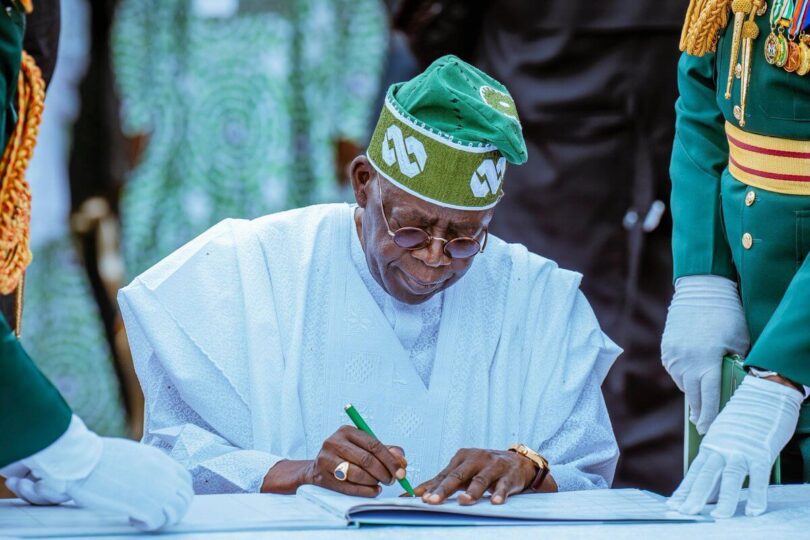
President Bola Ahmed Tinubu’s directive to the Economic and Financial Crimes Commission (EFCC) to return to court and seek the discharge of the order freezing the accounts of the Osun State Government is a commendable and timely intervention. At a moment when public trust in the neutrality of state institutions is often strained, this decision sends a clear and reassuring signal: that the Federal Government must not, under any circumstance, be seen as influencing the outcome of an electoral process.
The President’s position reflects a critical democratic principle — elections must not only be free and fair, but must also be perceived as such by the electorate. In politically sensitive periods, perception is as powerful as action, and any move capable of casting doubt on institutional neutrality must be carefully addressed. In this regard, the directive demonstrates a conscious effort to protect the integrity of the forthcoming Osun State governorship election.
However, beyond its political significance, the manner in which the President has approached this issue is equally important. Constitutional democracy demands that even well-intentioned actions must follow due process. The EFCC operates as a statutory body with clearly defined investigative and prosecutorial powers, while the freezing of Osun State’s accounts is rooted in a subsisting court order. Such an order cannot be set aside by administrative fiat but must be challenged through established legal procedures.
By instructing the Commission to return to court rather than pursue any extra-judicial resolution, President Tinubu has reinforced the supremacy of the rule of law and the central role of the judiciary in resolving disputes. This approach not only preserves institutional integrity but also strengthens public confidence in the constitutional process.
Nigeria’s democracy rests firmly on the principles of separation of powers and institutional independence. These principles are best upheld when each arm of government performs its duties without overreach, while respecting the constitutional boundaries of others. The President’s intervention, therefore, must be seen not as interference, but as a reaffirmation of these foundational ideals.
More importantly, this decision sets a necessary tone for all stakeholders involved in the electoral process. Security agencies, the Independent National Electoral Commission (INEC), election observers, National Youth Service Corps members serving as ad hoc officials, academic Returning Officers, political parties, candidates, the media, and the judiciary must all take a cue from this commitment to neutrality and constitutional discipline.
The message is clear: the credibility of elections is a collective responsibility. Every institution and individual involved must act with restraint, professionalism, and fidelity to democratic norms.
Ultimately, elections are not merely contests for power; they are tests of a nation’s commitment to democracy. History will not only judge the winners and losers but will scrutinize whether those entrusted with authority upheld the sanctity of the process.
Free and fair elections are not optional — they are the bedrock of legitimacy. And in this instance, President Tinubu’s directive stands as a necessary reminder that the rule of law must remain the guiding principle in safeguarding Nigeria’s democracy.